 Timeline
Timeline
Timeline

According to state records, Abram Gale (1796 – 1899) purchased 320 acres of land for $400 in sections 31 and 32 of township 40N, range 13E. Sayre purchased 218 acres of land in this same area for a total of $284.14. Patents from the land office for the land were granted in 1841. Other land purchasers in the area included members of the Lovett and Rutherford families.
These types of land grants were sold to white settlers under the rules of the Land Ordinance of 1785 after the 1833 Treat of Chicago that forced local Native Americans (The Chippewa, Odawa, and Potowatomi) off of the land in what would become the Chicago area.
Image Source: General Land Office, Bureau of Land Management, US Department of the Interior

Jefferson Township was a civil township that existed as a part of Cook County from 1850 to 1889. The boundaries of the Township stretched as far north as far north as Devon, as far south as North Avenue, as far west as Harlem, and as far east as Western. Much of Gale and Sayre's lands existed within these boundaries.
The above map of Jefferson Township was included in a 1911 book entitled The Township of Jefferson, Ill. and “Dinner-Pail Avenue” by Alfred Bull.
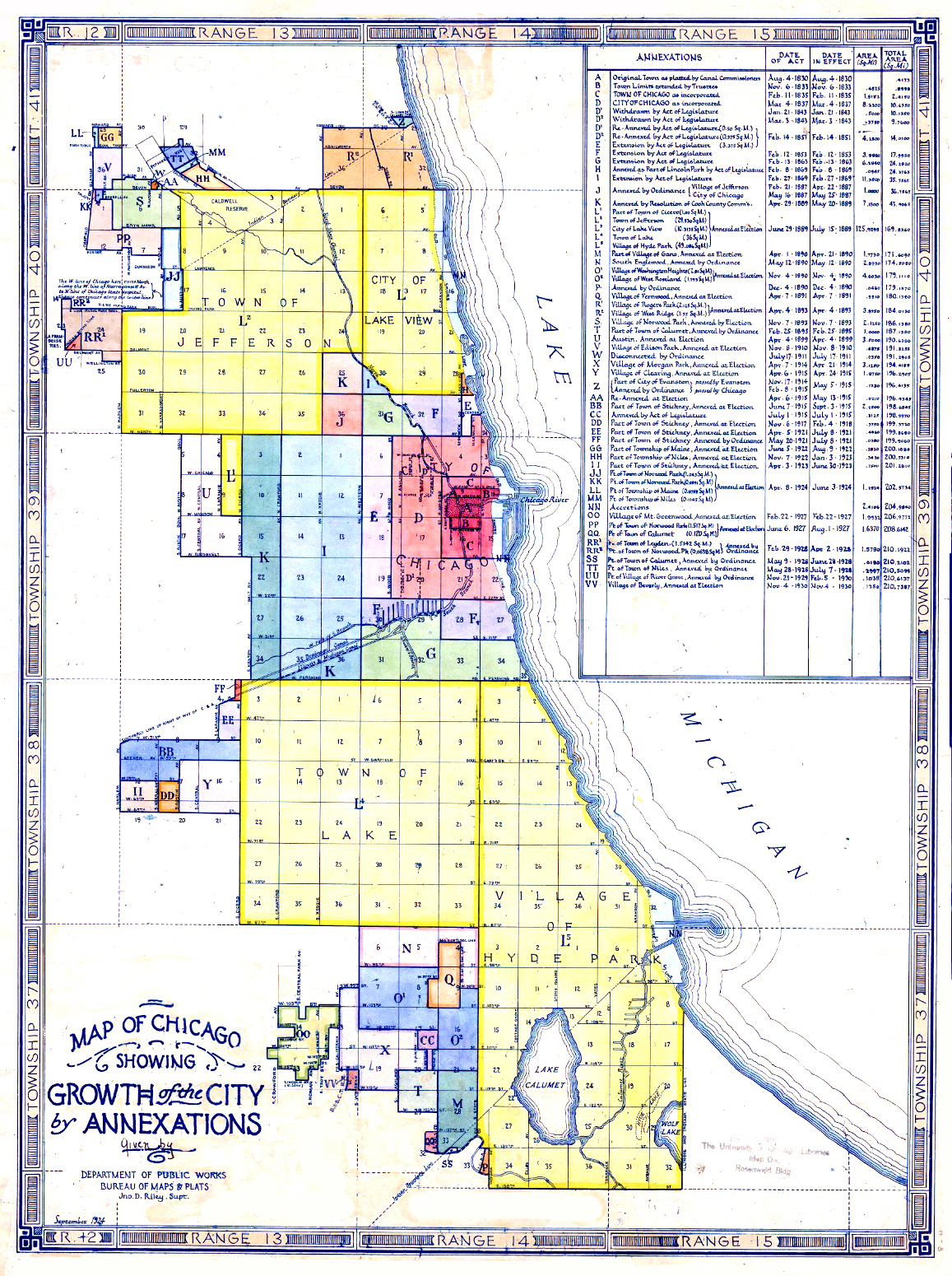
Jefferson Township was annexed into Chicago as a part of the Great annexation of 1889, after voters in Jefferson voted in support of the measure. Jefferson and other suburbs of the growing Chicago were enticed to vote for annexation by the improved sidewalks, sanitation, water, police, and fire services they would receive if their towns joined the city of Chicago.
Image Source: Chicago Department of Public Works, Bereau of Maps and Plats. 1930. Via the University of Chicago Map Collection

On the newly leased land, the club built an 18 hole, 4 mile private, members only course and clubhouse which opened in July of 1899. Westward Ho's course stretched all the way into present day Oak Park.
In 1923 the club abanded the Galewood course for new location at Wolf Road and North Avenue. After the Westward Ho Golf Club left for "greener" pastures, the Gale family opened their course to the public and operated it as the Galewood Golf Club, a public, daily fee golf course. This course operated until 1928.
Image Source: Worthpoint listing
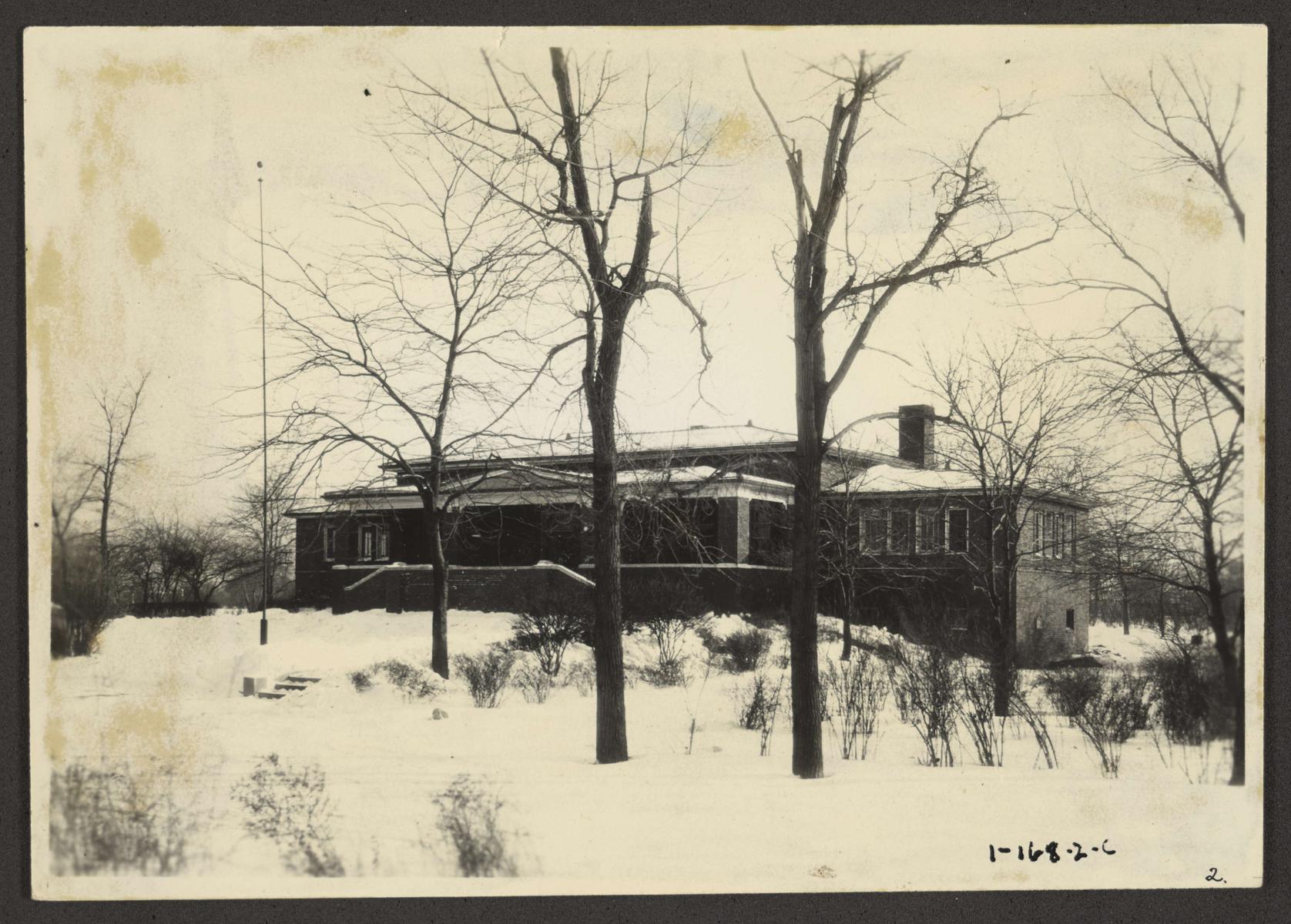
Emily Gertrude Merrill Rutherford, widow of Joseph William Rutherford, and Mary Sayre ALlen donated a combined 15 acres of land from their family holdings (10 acres from Emily Rutherford and 5 acres from Mary Sayre) to become parks. These two parks (Sayre & Rutherford Parks) would one day be joined to make today's Sayre Rutherford Park. They were both dedicated and opened as parks on September 18, 1909.
The park's fieldhouse, which still stands today was designed by W.C. Jones and built on the site in 1916. The parks officially joined the Chicago Park District in 1934. Rutherford Park, Sayre Park, and Rutherford Sayre Park were all merged into a single park by the Chicago Park District in 1999.
Image Source: Chicago Park District Records: Photographs collection, Chicago Public Library Special Collections & Preservation Division.

In June 1924, the Chicago Tribune reported that the Shriners Organization had purchased land in Galewood, just accross the street from Rutherford Park. The hospital, originally named The Shriners Hospital for Crippled Children opened in 1926. In the article reporting on the plan for this new hospital, the reporter noted that, "the hospitals are opened to crippled children of all creeds and without distinction of race." The hospital remains on the site to this day, now called Shriner's Children's Chicago, though the original building has since been replaced with the current design.
A popular neighborhood event/fair in the early to mid 2000s for families occured at the Shriner's Hospital grounds as a fundraiser. The fair often included a parade of Shriner's members on motorcycles.
The above image, sourced from an old eBay listing is a vintage postcard depicting the original building, chrome printed by Drew & Associates Publishing, La Grange, IL, date unknown.

On January 26, 1927, the location of the school was vacated by city ordinance, after which the public school building would be constructed. The school was serving students by the 1930s. It remains one of the primary neighborhood public schools for the area, serving Pre-K through Eighth gread students.
Image Source: Sayre.cps.edu

Lots were advertised for sale several times throughout the late 1920s, including the above advertisement printed in Chicago Tribune on Spetember 27, 1927. Other ads from 1928 and 1927 can be found in the "Gallery" section. At the time this ad was printed there were still potential plans for a continuation of the 'El' down North Avenue, all the way out to where Galewood is located, plans that unfortunately never came to fruition.
Image Source: Chicago Tribune archives via the Chicago Public Library
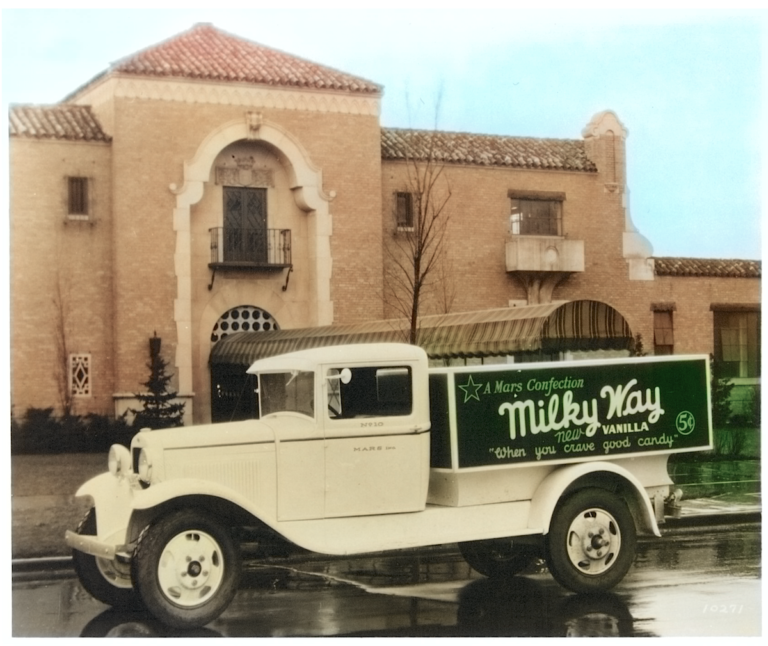
The plant, constructed in 1928 and designed by Cleveland-based engineering firm The Austin Co. is a single story Spanish Revival-style surrounded by clean, manicured gardens and landscaping. This design was chosen to make the building blend in with the coming residental neighborhood. When it opened in 1929, it was set to employ 300 people, 80% of whom were original employees of the company's former operations in MN.
After nearly 98 years of operation, the plant is set to close in 2026, but the building, which received Chicago city landmark status in 2024 will remain.
Image Source & Further Reading: madeinchicagomuseum.com

The first firm advertised as having an interest in building housing units was the David Gowdy Company (David Gowdy & John Duff). This firm took out just four permits for new homes in the area in 1931. They had purchased a large portion of the local land in the 1920s directly from the Gale family. No more was reported on construction from the David Gowdy Company — the next contenders were a firm called Mills & Sons, who scheduled to construct a small number of homes in Galewood and Ivanhoe in 1936. Both efforts were likely stymied by the Great Depression.
The bulk of the construction did not begin in earnest until the 1940s, per Chicago Tribune reports, when Carruthers & Braun got involved. The firm built a staggeringly large number of homes both in Galewood and in other suburbs in the early to mid 1940s. According to the Chicago Plan Commission, the firm had constructed constructed 281 homes in the Galewood area alone prior to 1945.
Image source: composite from a Chicago Plan Commission housed at the University of Chicago Library as a part of their Government Maps of Chicago in the 1920s, 1930s, and 1940s Collection.

Replogle Globes, Inc., founded in 1930 in Chicago is the world's largest manufacturer of globes. They had already moved production facilities a few times in the company's history, increasing in size each time, and their move to the far west side of Chicago was yet another increase in size. In 1954, the company opened their production facility at 1901 N. Narragansett Ave — a 75,000 square foot facility, employing 150 people. The company remained at this site until 1987. The building however, remains to this day and now operates as a corporate office and warehouse for Industrial Steel & Wire company.
Image Source & Further Reading: madeinchicagomuseum.com